Monday, 1 February 2016

A positive story about street children in Durban


Street Art in Durban 2009


When my family and I visited Durban and the Umthombo project for Street Children, Durban was very much at crisis point.  
In 2009, the city was getting ready for the Football World Cup and for the local metropolitan council, street children were getting in the way.  Crime was rife, tourists would get robbed and the council was  extremely worried about how this would put off would be visitors in 2010.  Street children were very much in the spotlight of blame for the crime.  So much so that there were numerous blue metropolitan police vans driving around the city , picking up street children and driving them out of town to be told not to come back, often with a beating.

The mobile health clinic that supported street children during the day from Umthombo.

The then director of Umthombo, would regularly meet with the council to express his concerns as to how street children were being treated and often there would be a stand off between the two parties.

Ironically the turning point for the city and street children, in particular, was the World Cup 2010.
Amos Trust founded an initiative called the Street Child World Cup.  To be held in the March of 2010, the event invited teams of street children from all over the world to come to Durban and represent their country at the first Street Child World Cup.

This was an opportunity to raise the profile of the plight of the children living on the streets and with the motto "I am somebody', the street children had an opportunity to move from being a despised problem on the streets to being representatives for their country.

Please help. Click here.


This competition forced politicians in different countries to really consider what was happening to these children and for organisations to work together to help them.

In more recent years I was pleased to find out that the numbers of children sleeping on the streets of Durban had been reduced massively, through Umthombo, the metropolitan council and Amos Trust working together.  Kids were reunited with their families and those that weren't had more resources available to help them turn their lives around.  
One exciting project is 'Surfers Not Street Children' set up by Tom Hewitt, former director of Umthombo where street children get taught to surf on the beautiful beaches of Durban and even compete, sometimes at international level.  This initiative has lead to the older street children to getting sponsorship deals, jobs and a great deal of respect.

By working together to support street children in Durban, great things have happened and this has been an inspiration to other projects all over the world, even changing policy in some countries such as in Pakistan.

This is why I am jumping out of a plane in July, because Amos Trust is making a real difference to the lives of street children through supporting local projects such as Burundi's New Generation or India's Karunalaya.

By supporting me in my jump you will play a part in making a real difference to a child who is often ignored on the streets, often blamed for crime, beaten and abused.  These kids have potential and the deserve to realise that potential.  

You can help me by following and sharing my blog or simply clicking the icon below to sponsor my jump.  Your support means a lot to me.  Thanks.


Monday, 25 January 2016

Military Court Watch

I follow the feeds from the Palestinian Solidarity Campaign and recently I discovered for myself via their website a web site called Military Court Watch.

This website monitors the treatment of children in Israeli military detention.

I wanted to share this with you and in particular the story of Tareq, a 14 year old Palestinian boy who was arrested for throwing a molotov cocktail. The problem is , he doesn't know how to make them and he was forced to sign a confession in Hebrew which he can neither speak or understand.  He signed it anyway to stop the soldiers from beating him.
It is not an unusual story and happens hundreds of times, but this abuse of children just doesn't seem to be making the headlines.

See below for the details about Tareq.

Testimony: O.I.A.

Name:O.I.A.
Age:14
Date of incident:18 October 2015
Location:Tuqu', West Bank
Accusation:Throwing stones/Molotovs

On 18 October 2015, a 14-year-old youth from Tuqu’ is detained by Israeli soldiers at 1:30 a.m. and accused of throwing Molotovs and stones. He is released without charge 17 hours later.
 
I woke up at around 1:30 a.m. to the sound of a loud explosion. It was the sound of Israeli soldiers blowing up our back door. My father got up and was shocked to see soldiers already in our living room.
 
The soldiers told my father they had come to arrest me. They gave my father a document but they did not tell him where they were going to take me and why they were arresting me. My father asked if he could bring me to the police station in the morning but they insisted on arresting me in the middle of the night. They wanted to take me in my pajamas but my father did not allow them. They allowed me to put on my boots but did not let me put on my jacket.
 
The soldiers then tied my hands to the front with three plastic ties: one on each wrist and one connecting the two. They led me to the main road where I was blindfolded. A soldier slapped and kicked me. Then they took me to a tent the soldiers had put up at the entrance to our village. They pushed me to the ground face down and I remained in that position until around 7:00 a.m.
 
I was then taken to the back of a jeep where I sat on a seat. The jeep drove for about 30 minutes towards the police station inside Etzion settlement where I was put in a courtyard. I sat on a seat for about 30 minutes. I was then taken to see a doctor who removed the ties and the blindfold and examined me. I was tied and blindfolded again and then I was taken for interrogation at around 8:00 a.m.
 
The interrogator removed the ties and the blindfold and accused me of throwing a Molotov cocktail at settlers. He did not inform me of any rights. I denied the accusation and told him I had no idea how to prepare Molotov cocktails. He then said in that case you I was accused of throwing stones at settlers and soldiers. The first round of interrogation lasted for about two hours. The interrogator also punched me in the stomach and slapped me and called me a fucker. He punched and kicked me again and I couldn’t take the pain so I decided to confess to throwing stones at soldiers on two occasions.
 
He then took me to see another interrogator who was in police uniform and had a tape recorder which he turned on. He told me to repeat what I had told the first interrogator. He then printed out my statement in Hebrew and asked me to sign it and I did without understanding what it said. I was afraid that if I refused to sign it he would beat me again. He then took my photograph and my fingerprints.
 
After the interrogation I was strip searched and taken to a prison cell in Etzion where I remained until around 10:00 p.m. I was allowed to use the toilet but I wasn’t given any food.
 
At around 10:00 p.m. I was shackled and handcuffed and taken to the back of a troop carrier where I sat on a seat. The carrier drove for about one-and-a-half hours and then stopped at Ofer prison, near Ramallah. At Ofer I was strip searched and taken into Section 13.
 
The following day I was taken to Ofer military court where I waited for about two hours. A policeman then told me they were going to release me. I did not see a lawyer and I was never taken inside the courtroom. I was taken back to prison and around 7:00 p.m. I was released. My parents were not waiting for me outside prison because they were not told I was going to be released. I took a taxi home by myself. I arrived home at around 10:00 p.m. 


Durban - The Washing Boy

The Washing Boy by John Hicks January 2015.


In 2009, my family and I had the opportunity to travel to South Africa for two and a half weeks.
We had planned to visit a street child project called Umthombo for the first week in Durban and then drive down to Cape Town from Port Elizabeth for the rest of our time there.


A map of our journey from in South Africa, from Durban to 'PE' to Cape Town.


I will be honest, I went with the attitude that I just needed to get through the first week in order to enjoy the following week and a half.
The first week was arranged by Amos Trust and Chris Rose was leading the tour.  Amos Trust raises awareness in the UK about many issues of injustice around the world and we were here to find out about the abuse of children who lived on the streets of Durban.

In the build up to going, I understood that Durban was a very dangerous place.  You wouldn't go out at night on your own walking around Durban as you were likely to get mugged (and that would be if you were lucky).  I had already heard about how Durban was the car jacking capital of the world especially as I was going to be hiring a car at the end of that week!

So I was fearful of being in Durban and had low expectations.  Actually that week turned out to be the best week of my life and in many ways changed my life in the years afterwards.


I will expand on my experiences in Durban in later blogs (as I will about my experiences in the West Bank) but for the purposes of this blog I want to write about the very first time I ever saw a street child in Durban.

On our first day in Durban, we all met in the hotel reception area and then walked over to Durban's beautiful beach.  It was a peaceful time of day with the sweetness of the warm sea breeze sweeping across us.  The temperature was lovely and cool and we all walked along the promenade with views of the sea and distant ships travelling to Durban's port..
We were all following Chris, I was walking around with 'tourist eyes' but also vigilant of any danger.  I had heard about gangs of street children running around stealing and mugging.  So I was nervous.

We all stopped at an agreed meeting point and about ten feet ahead of us was a dripping tap and there was a little boy probably no older than 10 years of age washing his clothes.  He wasn't bothering anyone, just having a wash.  At that point, my fear of dangerous gangs of street kids went out of my head and I saw the child that was standing there, alone in a dangerous city, just cleaning his clothes.

I was struck by how easy it is to be fearful of the gangs of Durban and see them as dangerous groups of kids , causing havoc, stealing, mugging etc.  In fact , at the time, the city was getting ready for the Football World Cup that was happening the following year.  The city council new that their city was famous for crime and these gangs of street kids and very much saw them as a deterrent for tourists.  The council regularly drove around in vans picking up the street kids and driving them 50 miles from Durban, giving them a kicking when they stopped whilst telling them not to come back.

But in that moment, I saw that child and yes the street kids did do all the things that they were accused of, but they were living on the streets of a dangerous city trying to survive.

That 'Washing Boy' changed my view there and then and left me wanting to know more about the life of a child living on the streets of Durban.


Friday, 22 January 2016

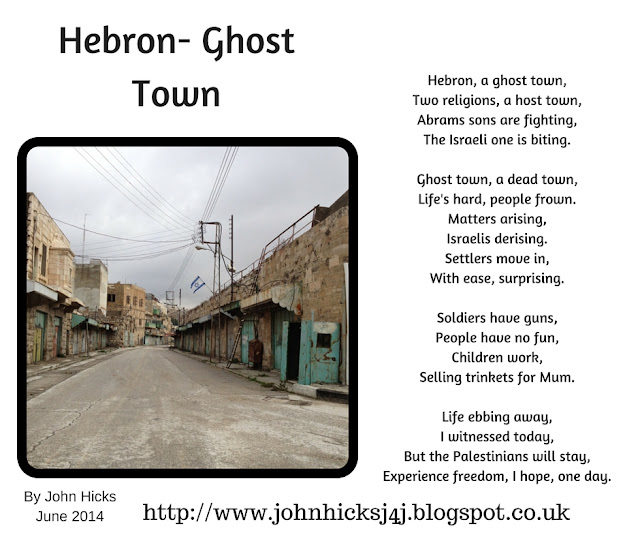
The Children Of Hebron

In recent years I have found that I have been increasingly more concerned personally and professionally about the welfare of children.

In my trips to Durban and Palestine, this was particularly pertinent, hence the skydive in July this year.

I was inspired in Palestine to write some poetry as I found that it condensed my thoughts really well about what I was seeing.  As I share my blog posts you will see some of these pieces as they explain what I saw better than what I could write now.  I felt raw at the time and the poetry brings back that feeling for me.

In Hebron, West Bank,  I walked through the market area a long covered street through the middle of the town.  I say it was covered because when I looked up there was a net and on that net was a load of rubbish.

What was happening here was that in the apartments at the top of the buildings, Palestinian families had been evicted from their homes and were replaced by Israeli settlers.  The settlers seem to all be orthodox Zionist Jews who believe that this land is theirs.  I don't have a problem with their religion or beliefs, but I have a problem with the way that they treat the Palestinians.

Back to that netting.... The reason for the netting being there is so that the rubbish being thrown out of the windows of the now settler owned apartments, can be caught and not allowed to fall on the people below in the market.

If I throw rubbish at someone here in the UK, I am pretty sure that they wouldn't like it and might even get the Police involved.  In Hebron, this behaviour (and other strategies for trying to push out the Palestinians) is protected by the Israeli Defense Force.  It would seem that Palestinians have no rights.
For me, I am saddened that there are kids living in this mess.  All around them is conflict, hate, distrust.  What kind of life is that for a child?  Lots of the kids I came across where selling trinkets on the market to make money for their families.

Please share this blog if you like the poetry, not for my benefit but because I hope that it will help others to understand more about the issues facing Palestinians and this of course means their children too.

Click here to see other poems from my time in the West Bank


Your sponsorship will change children's lives for the better.

Wednesday, 20 January 2016

Why I am jumping for justice.


Hi I am John Hicks.

I am nearly 44 and I live with my wife Diane and my two daughters Beth and Jess in Cambridgeshire, UK.  On July 10th,  I am going to take part in a tandem skydive raising awareness about human rights and raising money for the London based human rights charity, Amos Trust.  Today I received the all clear from my doctor and I have a certificate to say that I am medically ready to jump out of that plane!

Ooh er!  It looks like I am committed now!

One of the things that we love to do as a family is to travel and we have been to many different countries and explored different cultures.
In 2009, we visited Durban in South Africa, almost at the tip of Africa.


We decided to go there because we had heard a lot about a project that sought to help children and young people that lived on the streets of a city famous for violent crimes and abuse.
The project, Umthombo Street Child, gave street children a place to go for support and hope to one day be reunited with family or develop a better life for themselves.
Umthombo used sport (surfing and football), art and dedicated workers to reach out to those children, some of whom could be as young as four.
On one occasion, the then director of the project, Tom Hewitt MBE, said to me that every street child that I would have met will have had experienced some form of sexual abuse in order to be accepted into the numerous gangs in the city.  For many of those kids, being in a gang meant being 'safe' on the streets.
Considering what these kids had to deal with, they were always friendly to us and Umthombo gave them hope for the future, and opportunities to set away from life on the streets.

In June 2014, I was fortunate to visit another project based in Bethlehem in the West Bank, Middle East.


I was playing in a band for an arts festival and so by night I did the rock n roll thing and by day I visited places where Palestinians lived.
On one occasion I visited a family just outside Bethlehem and they gave me a seat under an olive tree and served me tea.  I played with their kids for a while too, I tried to teach them to juggle.  They thought it was funny.


The only problem with this scene, was that in the background lay the demolished house of that family.  The Israeli Defence Force, gave them an hour to abandon the house before a bulldozer smashed it down.  This was the start of Israel taking their land, which the family had owned for generations, and trying to force the family out.
Despite this, they welcomed us and gave us what little they had and told us their story.  Their water supply which was a borehole was even demolished by the bulldozer so as to make life really hard.

You can read about my visit there by visiting my blog which includes photos, stories and some poetry that I wrote about my experience.  Click here

In both South Africa and in The West Bank, despite what is happening at a political level, children's lives are being negatively affected by the selfish actions of adults.  These actions take away justice and hope for these children.

I am committed to doing what I can to change situations like those described and I am doing this by raising money for The Amos Trust, a UK organisation that supports grass roots organisations in countries that rebuild hope and restore justice.

This is why I am going to jump out of a plane at 15000 ft in a tandem skydive. As I do this I will think of those kids that I have met, some of whom have died at the hands of people that do not champion hope and justice choosing to oppress, damage and belittle the lives of children and adults that have such potential.


I will write more blogs about my upcoming experience and about the experiences that have led me to do the skydive. I hope that I can help you to understand some of what I have seen and maybe even get involved yourself.

For now, if you would like to very practically get involved, I would be delighted if you could sponsor my jump by clicking the banner below or at the very least simply share my story to your Twitter, Facebook or Google accounts.

Thanks for listening.

John